Thursday, January 27, 2011

The Good Stuff: Magnesium

 I'm frequently asked which supplements I take--it's a fair question since the person asking is usually someone I just suggested take this or that. My answer: not much of anything, but what I take gives the most bang for the buck. Today I want to spread the love for a supplemental underdog, our old friend magnesium.

Magnesium is found naturally in green leafy vegetables of which we both know you're not eating enough. It's also found in nuts, legumes, and sea food. A quick list of the punch this mineral packs: glucose metabolism, cellular energy transport, calcium transport, nerve signal conduction, over 300 enzymatic reactions. Lack of magnesium in the diet is known for contributing to the following list of stuff I'd rather avoid:
  • Muscle weakness, tremor, or spasm
  • Heart arrhythmia, irregular contraction, or increased heart rate
  • Softening and weakening of bone
  • Imbalanced blood sugar levels
  • Headaches
  • Elevated blood pressure
  • Insomnia
  • Muscle Cramps
  • Panic Attacks
  • Hyperactivity

I've written about C-reactive protein (CRP) before, but to review, it's a blood test that measures a marker for systemic inflammation. It is often used to determine one's risk for a coronary "incident." A recent paper, however, shows that elevated CRP means you're at risk for all the inflammatory diseases of the west: cancer, heart disease, and so on. Another recent paper shows a correlation with inadequate dietary magnesium and elevated CRP. One of the diseases that shows up in my family history, and is at least in part a disease of uncontrolled inflammation, is dementia. And I don't want that. Therefore--I take magnesium.

Another important factoid on magnesium supplementation: it helps prevent, and even reverse, bone loss in post menopausal women. Along with that fact, you should know that calcium supplementation doesn't appear to do squat for bone loss. See the abstract here. That paper discusses women on hormone therapy, but my inclination is to think that magnesium, not calcium, is the way to go if you're at risk of developing osteoporosis. Mrs. Green supplements, too.

Another paper I reviewed while writing this post makes a strong case that many of us are deficient, and had this to say about the consequences of that deficiency:

"Patients with so-called exclusion diagnoses (as for example,
attention deficit hyperactivity disorder (ADHD) or chronic
fatigue syndrome (CFS) would have their symptoms improved
through Mg therapy.—Similarly, patients with diagnoses of
depression, epilepsy, diabetes mellitus, tremor, Parkinsonism,
arrhythmias, circulatory disturbances (stroke, cardiac infarction,
arteriosclerosis), hypertension, migraine, cluster headache,
cramps, neuro-vegetative disorders, abdominal pain, osteoporosis,
asthma, stress dependent disorders, tinnitus, ataxia,
confusion, preeclampsia, weakness, might also be consequences
of the magnesium deficiency syndrome."

Yikes!

I routinely recommend magnesium supplementation for headache sufferers with great results. It's also in my arsenal for hypertension control (along with CoQ10, which I'll address soon), and the final icing on the (gluten free) cake: it helps you sleep better. And good sleep alone can do quite a bit for a tired soul. This article in the Huffington Post calls magnesium a "chill pill" and describes how it helps you deal with stress.

I'll get into some more of the supplements I take in the days to come. It's a short list, and I've already written about vitamin D, which is my favorite supplement, here and here. Magnesium, though, is a close second. They both have anti-inflammatory functions, and of course we sell them both here at Green Chiropractic. As an aside. it may be worth reviewing my post on supplement quality before you run off to your local mega-mart to buy any of this stuff...


Monday, January 17, 2011

But What About Potatoes?


With the whole no grain challenge I've been getting the same question thrown at me repeatedly: can I eat taters? And of course, the answer is far more than a simple yes or no. Let's have a look at the good, the bad, and the tasty when it comes to these tempting tubers.

Like usual, let's get the bad news out of the way first: potatoes will definitely spike your insulin levels, which is one of the same reasons I advocate avoiding grains. If you're trying to lose weight and get healthy, keeping your insulin levels low and your sensitivity to insulin high is the order of the day. Like I said in the grain post, you only have so much storage capacity for glucose (stored as glycogen in your muscles and liver), and when those cells are full the remaining is shuttled off to your fat tissue. One of the big problems with extra fat is that excess adipose tissue is full of cells that essentially pump out inflammation at an alarming rate, and many of the diseases of the West are diseases of inflammation that's gone unchecked for too long. Even the main stream media is finally getting the message that fat doesn't make you fat.

It's not all bad in tater town, though. Potatoes have a decent omega 6 to 3 ratio of about 4:1. Grains, for example are almost all omega 6, and an imbalance of fatty acids is one of the main culprits in producing a pro inflammatory body chemistry. When I give nutrition lectures I speak of the "three legged stool of healthy eating." Leg one: eat to control inflammation. One of the main ways to do that is to maintain a balance of omega fatty acids, and  since potatoes have a decent ratio they satisfy that leg of the stool.

Leg two is keeping your acid/base balance in check. Your blood Ph is slightly alkaline, and when you eat too much acidic foods like pretty much all protein sources, alcohol, caffeine, dairy, and especially grains, your body has to buffer the load back to alkaline. Fruits and veggies are, for the most part, alkaline, so the idea is that you should eat some protein (acid), and buffer with vegetation. And potatoes, my friends, are alkaline. For those keeping count, that satisfies two legs of the three legged stool. Foods that get this far are cheat foods in my book, and if you time an intense workout and a tater eatin' session just right you can even use the higher glycemic index of potatoes to your advantage.

Leg three, by the way, is keeping your insulin levels in check, which we've already discussed. Sneaky, huh?

When I eat potatoes I try to make it on days when I've worked out hard doing something intense like sprints. Other examples are lifting heavy weights or even your own body weight. The key is to burn the glycogen stores out of your muscles first, so the insulin surge you get when you eat a starchy carb will actually get it's job done without resorting to putting more fat in storage. High intensity exercise on a regular basis will also make your cells more sensitive to insulin so your pancreas won't need to work so hard in the first place. Check back in the near future for a series on exercise...

If I haven't done much working out on a tater eatin' night I try to eat small portion of potatoes in combination with a much larger amount of vegetables of the green variety, which can help modulate the overall glycemic impact. Sweet potatoes, by the way, are lower on the glycemic index than regular potatoes, which I find odd, since they contain the word "sweet" in their name.

So, potatoes. A two-legs-of-the-stool cheat food, and a post high-intensity workout food, too.

See? It's not all bad news around here! And if you have neck or back pain, give us a call at Green Chiropractic!

Tuesday, January 11, 2011

The Good News


Well now. That last post sure did generate some controversy! In one day it received more hits than my previous number one (the fish oil article) by more than double, and it's still climbing. Much of the feedback has been positive, actually--there are plenty of people out there who have cut grains out in the past, but then let them sneak back into their lives. Their stories are replete with anecdotes about how few and far between illness visited their households, how much better they felt in general, and, once they got into the groove, how easy it was (for a time) to maintain the grain free lifestyle. I had some detractors as well (as expected), many of whom don't take the post seriously (although seriously enough to respond) because I didn't cite the references I used.

So, before the good news, I suppose I should respond to that charge. First off, I write this blog between patients at my office, and, fortunately, there is getting to be less time  between. As this is a blog rather than a scientific journal like, say, Spine, I don't worry too much about the references. I have had plenty of people email me and ask for more information, in which case I give references and so forth.

I love talking about this kind of thing, but in clinical practice I have to focus on the one or two points I can try to get across before the patient tunes me out. I write these kinds of articles as a resource that people can read at their leisure. I always welcome comments and questions, and almost always mention that all my contact information is on the Green Chiropractic website. So don't hold back--ask! Also, it's worth mentioning that these posts shouldn't serve as an official diagnosis or treatment--you have to come to the office to get that.

People have a hard time letting go of grains in part because they're somewhat addictive, as is the nature of carbs. The insulin surges that come with their intake create a day in, day out rollercoaster effect, and  can lead to mood swings and irritability. And like I said in the previous post, filling up your muscle cells with glucose doesn't take too long--the rest is then stored as fat. Walking around with an extra 20 or more pounds of fat isn't all that great for one's psychological status either. The inflammation excess grain consumption causes often manifests clinically as low back pain, joint pain, and even depression. I have one paper (a case study) that details symptoms of schizophrenia related to gluten in the diet.

All grains aren't the same, but the wheat, rye, and barely that I mentioned in the previous post are among some of the bigger troublemakers because of the fact that they contain gluten. The others still contain lectins, phytic acid, and are acidic compared to fruits and veggies. That acidity causes your body to use certain minerals as a buffering agent because human blood Ph is naturally slightly alkaline (between 7.35 and 7.45). Anything too acidic, and your body will mobilize various buffering agents to keep things in that small window of alkalinity. Some of the agents used are magnesium, calcium, iodine, and potassium. We're often deficient in one or more of those, and the metabolic consequences can be anything from headaches to muscle cramps. And of course, too little absorption of calcium can be a problem for those dealing with osteoporosis.

The answer? Eat a whole lot of vegetables. A whole lot. Like, a bunch. To lose weight you need a nutrition dense food that is low on calories, and that describes vegetables perfectly. Anything good to be found in grains is found in far greater concentrations in vegetables. And in vegetables there are little to none of the "anti nutrients" found in grains. Nobody ever got small intestine bacterial overgrowth from eating too much grilled zucchini. Another way to get the calories that you need, as well as plenty of the basic building blocks for your cells is to eat more fat. Time for some more controversy. Here goes.


Fat doesn't make you fat. If you're going to cut grains out of your diet you're still going to need a certain amount of calories to give you the energy you need. Most of those calories are going to come from delicious, flavorful fat. Of course, there is always more to the story, and there is with this one, too. The types of fats you eat are either pro or anti-inflammatory depending on where they came from. For example, grain fed beef eat, um, grains, which are high in the omega 6 fatty acids we discussed in the previous post. We are what we eat, and they are too. So eating fatty, grain fed beef, although delicious, can cause some of the same inflammatory diseases that eating grains cause.

I know not everyone reading this is in Texas, and I truly feel sorry for you if you're not, but here in Texas getting grass fed beef is easier now than it ever has been. For everyone not in the Promised Land, you can find sources of the good stuff at Eat Wild. Cows like to eat grass, you see, and when they do they have the bonus of accumulating fatty acid profiles that favor a higher omega 3 ratio. This type of fat packs your cell membranes with anti-inflammatory raw materials that drive tissue healing. These animals don't need tons of drugs pumped into them either, which is typical of feed lot cows that are force fed grains in the last several months of their lives to fatten them (and consequently, us) up. Other sources of omega 3s are cold water fish and wild game, which also all happen to be both delicious and abundant here in The Promised Land.

Other fats that do a body good are two that we keep on hand here at the Green Compound: coconut oil, and ghee. These fats are mostly saturated fats, and (time to get controversial again) are extremely healthy. For coconut oil we get the big ol' plastic tub from Wilderness Family Naturals, and for ghee, well, we make our own.

Saturated fat is much more of a dietary necessity than the food police have been wanting you to believe. A large chunk of your cellular membranes are made from it, and some (especially those found in coconut oil) even have anti-microbial and anti-fungal properties. It's  also much more stable than the omega 3s and 6s because of its structure, and therefore harder to oxidize. Oxidation leads to all the free radicals you've been hearing about for years that can gang up on your DNA and make it turn into mutant DNA, and unfortunately, that won't give you cool super powers like an X-man. Just illness. Sorry. Like a friend of mine says, though, I don't write the mail, I just deliver it.

You may not happen to have a freezer full of grass fed beef. If you're buying meat from the grocery store, I say go for the leanest cuts as they'll have less of the bad omega 6 fats in them. By the way, have I mentioned that bacon is mostly saturated fat? Have I mentioned that bacon wrapped shrimp is consequently a health food? See, it's not all bad news. I can easily give up the wheat flour biscuits for bacon and coconut flour pancakes. (I am excited to say, that my wife is making some kind of biscuit out of almond flour for breakfast, God bless her.) (I'm now happy to say that they were indeed delicious).

So to reiterate, the goal for the next 30 days is to drop the grains from your diet, and add more, much more, vegetables and fruits. If you've gotta have some starchy carbs you can cheat a little with sweet potatoes, and the occasional serving (serving is not a big pile, by the way) of regular potatoes which have a decent fatty acid ratio, and are alkaline, too. Those cheat foods can be used by your body especially after intense exercise, which will be the subject of a future post.

One last thing: I have no vested interest other than your health (and driving prospective patients to my website) when I write this stuff. What I do have is the experience of having had one of the foremost nutrition experts in the world as a mentor for almost a year (click that link and start reading the stuff in the tables. And all the references are at the bottom). If I have a bias, it's to eat crusty bread, tortillas, and pizza, cause I think all that stuff is tasty. Sometimes I do eat that stuff, but for the most part I practice what I preach, and I'm far healthier at 40 than I was at 30 when I didn't know any of this. It's my desire that you get healthier too, and if you have back or neck pain, that you come see me at Green Chiropractic.

Monday, December 27, 2010

Sitting and Your Neck Pain

More people than ever sit in front of a computer for a living these days, and if you're reading this it's likely that you're one of them. So before you get back to being productive for your boss, let's review some ways you can spare your neck in the process.
First, the basics: Your head weighs, on average, about 12 pounds. You have a fairly complicated series of joints and muscles holding that weight off your shoulders and giving you the freedom to look around. Like every other complicated system, the more moving parts to deal with, the more likelihood for something to go wrong. Some of the muscles that get tweaked and stretched when your head moves too far forward (the classic computer posture) are the deep flexor muscles. That would be these guys:
These muscles work in concert with others in the posterior part of your neck to give both stability and freedom of movement to the head. They also get beat up when we get our heads too far forward and keep them there all day, like you may very well be doing right now. Interesting fact--every inch forward your head moves takes three times more power to support the weight. Makes sense--if you hold a bowling ball close to your body it's easier to support than holding it out in front. And your head weighs about the same as a bowling ball. No disrespect.

Eventually, certain muscles get too tight which causes others to turn off ("reciprocal inhibition," again). This happens because muscles activated on one side of a joint cause the muscles on the other side of the same joint to become inhibited--when you flex your bicep, your tricep has to turn off so you can perform the movement. Your neck is no different, and when it happens for hours on end in only one direction neck pain is often the result. This is sometimes referred to as "upper crossed syndrome." It looks like this:
Upper crossed syndrome can lead to a wide variety of pain and instability problems, including shoulder pain, pain around the shoulder blades (especially at the upper, inside border), and, of course, neck pain. None of which is very fun. 

Incidentally, the shoulder pain I just referred to is more than just pain, it's lack of stability. The shoulder blades are essentially the reason your shoulders move the way they do, and the serratus anterior muscles you can see in that picture (the ones that get inhibited) are important when it comes to stabilizing your shoulder joint. If they get turned off and you go try throw a softball around or swing a racket of some kind you could be in for some shoulder issues. More on that in a future post.
An ounce of prevention, as they say, so let's look at the exercise I give every patient with neck pain who walks in the door here: The Brugger. This is done while sitting on the edge of your chair. Step one--tuck your chin straight back while keeping your eyes nice and level. This will create a really nice double chin that you can be proud of. Step two--try and keep your head in position while placing your palms in a a forward facing position with your arms slightly bent and back a little. You should feel a nice stretch where your chest connects to your shoulders.You'll be in this position at the end of the movement: Hold this position for three deep breaths and then go on about your business.

Sometimes the neck pain associated with the upper crossed syndrome is due to joint restrictions in your neck. Static postures held for hours on end can cause the joints to stop moving like they should, which can often lead to pain. Classically, the base of the neck (where your neck connects to your body) gets locked up, and when the muscles of the shoulders join the party to protect the compromised joint, the combination drives people to my office. The joint right at the base of the skull is another key location for dysfunction, and the combination of those locations can cause blistering headaches with a fairly predictable pattern, such as this:
Fortunately, those headaches respond quickly to manipulation of the affected joints, especially when combined with soft tissue work to release the trigger points in the muscles. I recently had a patient leave the office with tears of joy welling up in her eyes because her chronic headache had disappeared for the first time in about a year. 

So do your Bruggers, and take your eyes off the screen and focus on something on the other side of the room while you do them. This will help your back, neck, shoulders, and your eyes, too. Why don't you start now? And if the headaches have already begun, and this doesn't make them go away, come see me at Green Chiropractic. Tell 'em the blog sent you.

Tuesday, December 21, 2010

Some Thoughts on Back Surgery

Yesterday I had the opportunity to see a spine surgery up close and personal. The procedure is known as a spinal fusion, and is the final stop up the totem pole when it comes to treating lumbar instability. I am very grateful to the surgeon who let me in his OR--he was quite gracious the entire time, and introduced me to the OR staff as a new chiropractor in town who wants to see what goes on in a surgical setting in order to better serve my patients, which is true. All the OR staff seemed interested in the fact that I was invested enough to come and observe, and several asked me questions about what I do. Nobody acted like I had nine heads when the word "chiropractor" was used to describe me, either. A good sign.

I met this surgeon years ago, and he made the offer way back then to see a surgery if I ever wanted. I had to use Facebook to track him down, but when I finally got in touch with him he was still just as willing to let me in his world for an afternoon. We met at the hospital and he led me through the maze of behind the scenes hallways and rooms to the OR. Before that, I should mention, was a trip through the surgeon's suite, complete with drinks and buffet style food set up all for free. Free!

Just outside the OR was the "scrub in" area. We talked about his first day to ever go through the procedure, which is radically different now with all the germ killing disinfectants made for these situations. Then we went in. There, all laid out in a very organized way, were all the tools and accoutrements needed to fuse someone's lumbar spine together. It was an impressive display that took up two tables to hold it all. There was also a full time tool-getter handing off one thing and cleaning the blood and bone chips off the other.

The only word that describes the procedure itself is a word that I think is largely overused, and consequently a word I tend to avoid: surreal.

There was Christmas music, which was changed to classic rock being piped into the OR as the incision was made that revealed someone's spine. There were some rather gruesome sounds coming from the procedure itself--the muscles and soft tissue attached to the spine have to be moved out of the way to insert hardware, and there's no amount of onomatopoeia in my power to type out what that sounds like. There was also a great deal of hammering with a chisel to get the hardware inserted and aligned. Hearing Steve Miller playing Rock' N' Me while that hammering was going on may just stick in my mind forever.

To be sure the hardware was lined up in all the necessary angles and orientations, a fluoroscope was brought in. A fluoroscope is an x-ray unit that runs continuously to see things in motion. I should mention that the surgeon nailed it on the first try.

Just before closing I was invited to take a look at table side, so after even more sterilization procedures I got a look at everything from inches away. With Jefferson Airplane's White Rabbit in the background, I got an intimate view of the amazing anatomy underneath our skin: The lumbar spine that had failed this patient to the point where this entire process was necessary, the muscles around it and the sacrum below it. Although it appears that the lumbar spine is fairly close to the surface, it's actually buried farther down than you might think. This patient was petite, and her spine was about six inches deep.

The take home points for me were these:
1. The stability of the lumbar spine is important. Doing core work shouldn't be considered a fad, it should be considered a necessary component to having a healthy spine. Look for some core stability posts soon.
2. Spine surgery is hard work. The good doctor had to use some muscle several times during the procedure. He was also exceptionally focused. He has his share of back problems himself, and has even had a fusion, so he could definitely sympathize with the patient.
3.Classic rock is superior to seasonal holiday music for surgical interventions.

Friday, December 17, 2010

Desk Jockeys Continued...

In the last post we talked about tight hip flexors and how they turn your glutes (butt) off and some of the potential consequences of that scenario, none of which are good: knee pain, ankle pain, etc... And who wants that? About the same amount of people who want a weak, mushy butt.

Tight hip flexors can also lead to low back pain, too, and as you might imagine is something I find myself explaining with some regularity here at Green Chiropractic. First, let's review the anatomy:
As you can see, your hip flexors, when contracted, will lift your thigh toward your body. You'll also notice one particular group, the psoas, connects your spine to your femur. This is the reason many office workers/desk sitters/couch potatoes have low back pain. It's a matter of mechanics. When the psoas is too short the lumbar spine is pulled forward. This hyper extension puts undue stress on the facet ("fa-set") joints of the posterior lumbar spine. Once that happens pain is soon to follow.

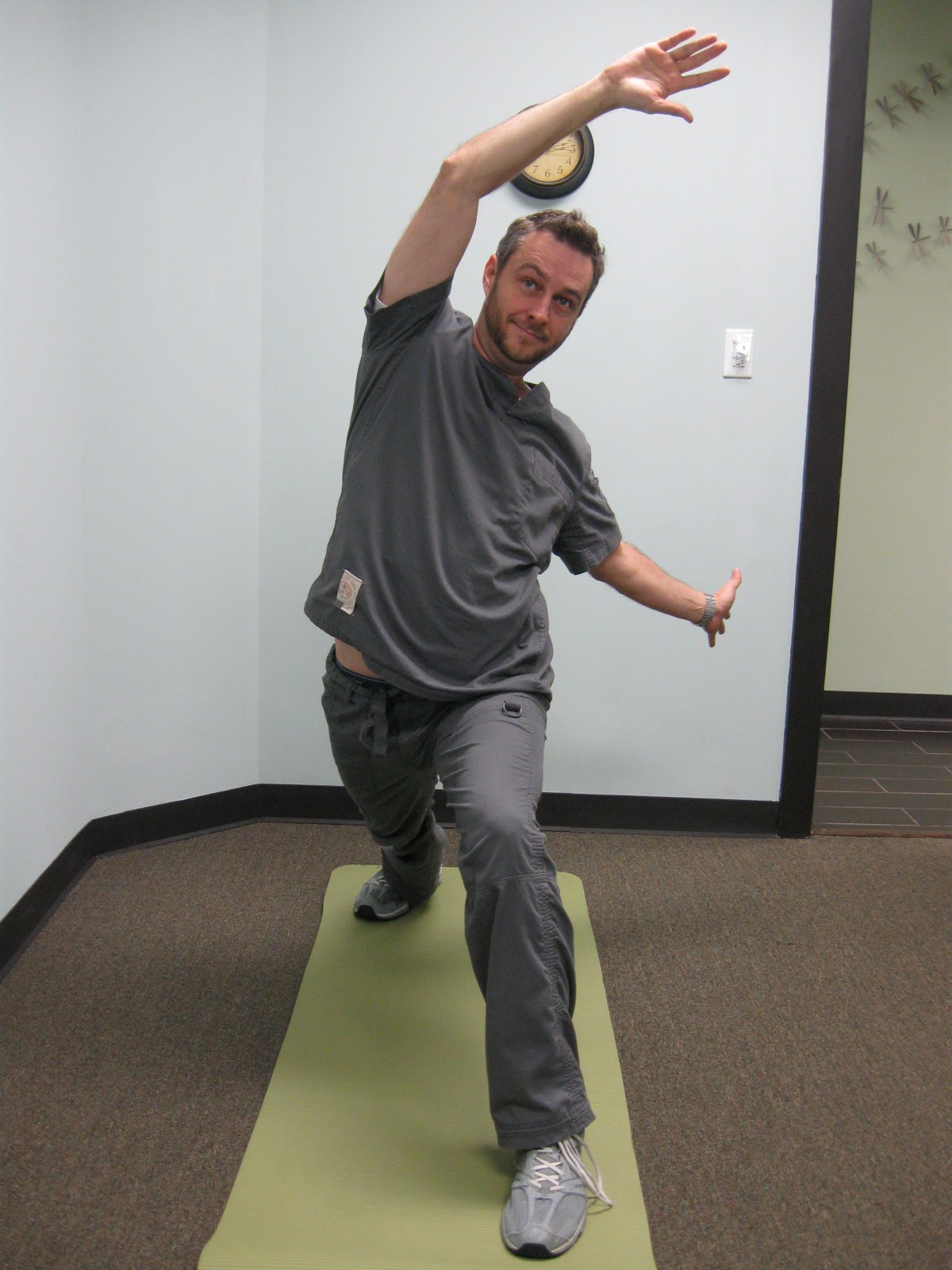
Fortunately, treatment is fairly straight forward--spinal manipulation can open the joints up and give them some breathing room, and some simple stretches will, over time, lengthen the hip flexors that are causing all the trouble in the first place. And so as not to leave you hanging, here are some pics of those stretches:
 Pete demonstrates the basic stretch for the left hip--hard on your knees without the mat.

 Raise your arms up to sink further into the stretch.

 The standing version

 By twisting and bending away from the hip you're stretching you can get a little more out of the movement

Wednesday, December 15, 2010

Attention Desk Jockeys

I'm a fan of computers and all, but sitting all day is bad for your back, bad for your neck, and bad for your sense of well being, too. I know--I'm writing this while sitting, and if it weren't for the fact that I regularly show (and therefore do myself) people exercises to help recover from the excesses of sitting, I'd likely end up with back pain myself. That scenario is not a practice builder.
What's so bad about sitting? I'm glad you asked--first off, prolonged time in any position can shorten certain muscles and lengthen others beyond the norm. Sitting though, especially at a desk in front of a computer, can really wreak havoc on the low back and neck. Let's start from the bottom, at the hip flexors. That would be these guys:

That one muscle, the psoas ("so-as") is especially prone to shrinking to fit the shape it's called to be conformed to all day long. As a result, we get tight in the front of our hips. Right here:
When a muscle is shortened it is essentially flexed. You have built into your muscles a mechanism (called "reciprocal inhibition") that causes muscles on the opposite side of a joint to relax to enable the contracting muscle to contract unimpeded. As an example, when you flex your biceps, your triceps relax so your arm doesn't tear off or explode with all that raw power.

In the same way, when your hip flexors are contracted, and end up shortening after all day sit-a-thons, the muscles that are forced to relax are found beneath your back pockets and are known far and wide as your glutes. Also known as your butt muscles.

When your glutes get turned off because your hip flexors are contracted and shortened and therefore always a little too activated, problems in gait (the way you walk) can be the consequence. Because, you see, your glutes help extend your hip when you walk--in other words they help with the pushing off motion of taking a step. Go ahead, touch your own and extend your leg backwards to feel them activate.

When your glutes aren't doing their job, other muscles and tissues try to compensate, but there really is no other muscles that can do the job as well. This often leads to IT Band Syndrome when runners go from desk to the track with inhibited glutes. IT band syndrome results in pain on the outside of your thigh. You can see in the following picture that the IT band is in a key location to try and do something it shouldn't be doing when the glutes are fast asleep at the wheel.
The effects of sleepy glutes can eventually lead to knee pain and ankle pain as well--it just depends on how your system compensates for the faulty movement pattern.

Short hip flexors can also cause low back pain, which we'll explore in the coming days. I'll follow up with how sitting affects your neck, and then we'll get into some stretches and exercises that will help with both ends of you. You can usually manage these things yourself, which is good, but if you're in more that the usual pain it could be something that could use a more experienced eye, and if that's the case, come see us at Green Chiropractic. If you live in Houston, that is...