Wednesday, January 23, 2013

Practical Weight Loss Programming

My Garage

I've had many revelations over this last year or so of my fitness journey. I spent some time in a commercial gym observing trainers setting people up for future injury. I read more blogs about exercise and diet than should be allowed by law. I spent an entire year trying to master just three exercise movements (the squat, deadlift, and bench press). All in the name of finding or creating a program that would be simple to follow, give me results, and keep me healthy without overtaking my life.

After all, I'm married with two boys who, at least for now, want me around. I ended up spending a little money on a Craig's List deal and setting up a home gym in my garage, which has been great. I can fit in a quick work out on the weekend, and stir a pot in the kitchen between sets if I have to. Not having to drive anywhere or share sweat with anyone (or fume when some bro is curling in the squat rack or whatever) has been a sweet deal all around.

There are those of us who want to get into shape, and stay that way, in the most efficient way possible. We have families and limited time to get anything done in the gym. We are The Lone Gym Rats who may need a little guidance about programming or nutrition, but due to scheduling, personality, or some other reason, just can't commit to anyone other than themselves when it comes to getting fit.

Several months back I decided to look for a change in programming. I had been lifting weights on the same basic schedule for over a year, and the time felt right to mix things up a little. I started reading up on on-line coaching, and quickly realized that doing this remotely is easy with this here handy-dandy internet.

Initially, I searched for online help for basic programming. What to do when kind of stuff. How many reps? Sets? How much cardio? Once you start looking it's like opening Pandora's Box. There's simply too much stuff out there, and most of it is bad. Having my particular educational background helped me screen through a lot of stuff initially, but I'm no exercise physiologist. When it comes to the gory details of what makes us bigger, stronger, faster than before (and helps me look my best for my wife, patients, and impending 25 year high school reunion), I turn to the experts. And in my estimation, the guys who know the absolute most about fat loss and strength gain are body builders. It's their sport.

Besides, you can only do P90X or Insanity so many times before you get bored, hurt yourself, or get a scratch on the DVD (I did all three). And having some form of coach you can ask questions of is a really good thing when you need it. Having some accountability for your progress (or lack thereof) is motivating too, even if you favor the lone wolf method of working out. Ahem.

I say all of this as the background information. By the end of the year I had bought several e-books, consulted with one online coach for a particular nutrition protocol, and read a ton of stuff written by various coaches on  different programming methods. And I found something that I really like: an e-book written by a body builder who's stayed up on the research. And more than that, a community of people (online) who are going through the same program, asking questions and getting them answered. Pulling for each other. Pushing each other. And all being led by the man who wrote the book in the first place.

And whether or not you are following a "Paleo" style diet (or have other dietary restrictions or preferences) this can all work for you. The best time to start is yesterday. If you're looking to make some changes, and the luster of your New Year's resolutions hasn't faded into total apathy, but you find you need some guidance, check this out. Here's the link: Burn The Fat Inner Circle

The e-book in question is called Burn the Fat Feed the Muscle. I'd recommend buying the e-book before joining the Inner Circle, because you get two free months with your purchase.

You will be encouraged to set goals for yourself. Goals you can actually track. You will be advised to lift weights, which in my opinion is the single best way to change your appearance for the better (ladies included). It's a simple program, really, but it's not easy. Of course, if this stuff was easy, we'd all be lean and mean and I wouldn't write stuff like this.


Wednesday, July 25, 2012

One Year in the Gym

In July of 2011 I started a self experiment in creating better body composition by doing the least amount of work possible. I'm busy, after all, with a clinical practice and two small children and a wife. Everyone is busy. It's the way things are these days. I'm sure you're no different.

I decided to get back in the gym and lift weights. I've always maintained that nothing changes your body like resistance exercise. I've spent time dabbling in body weight exercises, and in my years in Florida I got in more than my fair share of surfing. But after nearly a decade of being out of the gym with any real dedication, and with a lot more knowledge this time around, I decided to put myself on a program. I also made some rules for myself. I wanted to get stronger and leaner without living at the gym. I also wanted to do something easily repeatable for my readers here and my patients at the office who are looking for more than pain relief.

Don't hear me saying that I have found the Ultimate Program or anything like that. I'm just going to break down my one year's worth of experience, both good and bad. Then I'm going to tell you want I plan to change.

Step one: lift heavy (at least what's heavy for me), and only do the big three of power lifting (plus chin ups, which are quite humbling). That's right--in the last year I have only done four exercises a week for a grand total of about one and a half hours a week. No cardio at all, other than a little surfing just recently (which felt really good, by the way). Cause not only do I hate cardio, I think that long treks on a treadmill going nowhere is a good way to harm your metabolism. Plus, like I said, I have limited time and so do you.

Here was my schedule for the last year:
Monday--Squats. Usually six sets including a few warm up sets.
Wednesday--Deadlift. Four to five sets. Makes your hands look pretty:
 Not too shabby, but I'm just getting started.

Friday (sometimes Saturday)--Bench press. Five to six sets. I also did the chins on bench day, although not as consistently as I should.

Each of those sets consisted of five reps each, except the chins, for which I did as many as possible. Easy!


This time around (as opposed to ten years ago), I got smart and kept track of everything in a log book. This made walking into the gym a more focused experience; since I was writing things down I had goals--mostly to break the record of the last workout. And the records were set. In my twenties and early thirties I did my share of lifting, but never with a plan or any real goals other than to look like Thor (I even had the long hair in those days). I can now proudly say my forty-something self is much stronger than my Thor me.

Of course, when I got back in the gym it was pretty sad. My old warm up weights had become my top set weights, and left me feeling brutalized for days. I had to schedule my exercises around certain days of the week because I found that after bench pressing heavy weights my arms wouldn't do what I need them to do to see patients (the adjustment is an impulse that comes from the pecs and triceps, which were both rather gooey feeling after the gym). I also got to experience brand new types of soreness that comes from doing the dead lift--something I never really attempted in the past.

One of the beautiful things about starting something like this is that the progress came really fast initially, which kept me motivated. It was embarrassing putting so little weight on the bar in the first months, but I found I was able to add five to ten pounds a week for many weeks straight. I didn't take long for me to feel a little more Thor like. Or at least Batman like, and he's cooler anyway (and yes, I know I'm mixing my Marvel and DC characters. I'm crazy like that).

The results? In one year I added 100lbs to my deadlift, about the same to my squat (I love squattin'!), and a little over 60lbs to the bench. Also my clothes fit quite a bit differently (in a good way), and my weight stayed exactly the same. My testosterone levels most certainly increased which has numerous benefits for a 40-something dude like myself, and I finally feel like I could wear a Captain America shirt without looking too out of place. You know, except for the fact that I'm a 40-something year old man in a super hero shirt.

The limitations of the program I just presented may be obvious, but let me give you my impressions anyway. First off, I got zero cardio training in. And when I say "cardio" I really mean "sprinting, or other high intensity training." Previous to this last year's experiment I had done the Beachbody program, Insanity. I got great results from Insanity, but the problem was the intensity and therefore the sustainability. Insanity got me nice and lean with a resting heart rate in the 40s, but I felt like I had been run over with a truck by the time I was finished. I was as lean as I have been in years, but could barely jog across the street because every joint in my body ached. Insanity is a 60 day program which is geared to beat you into the dirt and get you ripped, but when it's over there's nowhere to go but back to chubby town.

There was an interesting test that came along as I neared the end of the year--my gym had a competition to raise money for the Wounded Warrior Project. The goal was to see who could do the most push ups in 90 seconds. I had done exactly zero push ups since finishing Insanity, but wanted to support the cause. I was hoping to not embarrass myself, as there were about 70 people competing and watching. The results? I pulled off doing 100, and tied for third behind a Marine (103), and a guy who works at the gym (101). Sweet.

I think a combination of higher intensity training (like sprints or anything in the Insanity program) added to a solid resistance training program will be where it's at. And so goes my plans for year two in this experiment. I'll provide more details as I go, so stay tuned. My next post will detail the rather unusual diet plan I've been on for the last year as well.

One last thing to mention--I think joining Fitocracy.com was instrumental in helping stay on track over this last year. A great friend of mine, who happens to live in Florida, joined with me and we tracked each other and gave props for pushing on through. I've made some friends there along the way. Fitocracy is like Facebook for people who exercise. Join up and find greggreendc if you're looking for friends.

Tuesday, January 3, 2012

How to Increase Your Testosterone


This one is for the men. Specifically for the men around my age (early 40s) and older. Men who want to maintain not just their libido, but their muscle mass and health as we move forward into our Golden Years.

Guys, we have to maintain, or increase (if it's low) our testosterone levels if we want to maintain our health. Low testosterone levels will also make you a weak girly man who can't open jars. And we can't have that. Your testosterone level is the rate limiting factor for how much muscle mass you can keep. Your muscle mass dictates the amount of organ reserve you have. In other words, a little extra skeletal muscle influences how well your heart, kidneys, liver, and all the other organs work. I don't know about you, but I want that stuff to work really well.

One of the greatest problems that comes along with excess adipose tissue (fat) is the reduction of testosterone levels. This happens because adipose tissue leads to the conversion of testosterone into estrogen. This can lead to, among other things, a phenomenon known as gynecmastia--the development of female breasts on men. Not all that flattering. Increased estrogen leads to higher retention of body fat, and the vicious cycle continues until it's broken. My challenge: break it now.

The single best thing you can do to elevate your testosterone levels is resistance training with weights. Period. I know for some of you this conjures images of muscle bound bodybuilders who can't scratch their own backs. Let me clear that image up for you by saying that this just doesn't happen unless performance enhancing drugs are used. Resistance exercise can literally be the fountain of youth for men with waning testosterone levels, but you have to be smart about it. The more muscle groups stimulated simultaneously, the more testosterone production is enhanced. What that means is that the "big three" compound exercises--squats, dead lifts, and bench press--are the most bang for your buck movements. It also means that walking aimlessly around in the gym doing curls and other isolation exercises won't get you nearly as far. Increasing your testosterone will lead to increased muscle mass which leads to greater potential for elevating testosterone, so there's another cycle. Unlike the "extra fat leading to enhanced estrogen production cycle," this one is good.

You may be thinking that you don't have hours to spend in the gym, even though the payoff is potentially huge. Let me just say right now: you're wrong. It's a matter of priorities. If your health and well being mean anything to you, you can figure out how to do this. I have a busy clinical practice that closes at 6:30 every night,  two small children at home, and I pull this off. You can too. The preceding paragraph gives you the key: do the big compound movements and get out. My workouts last no more than 45 minutes. Often no more than 30 minutes. I'm not some huge bodybuilder looking dude (as you can see in the picture below), but I've greatly enhanced my testosterone production potential. Most of my patients and friends would never look at me and think under the shirt and tie is the kind of weight lifter's body that they see on muscle magazines with the spray on tans and all that nonsense. And I can still reach my back just fine, thank you.

Me. Still Able to Scratch.


Some resources for how to get started with a resistance program can be found with a quick trip to Amazon--Starting Strength by renowned strength coach Mark Rippetoe (also a Texan--bonus!) will teach you everything you need to know about correct form and a basic routine set up. Another well known resource is Beyond Brawn, by  Stuart McRobert. Read these two books and you'll know more than 99% of the gym rats out there when it comes to working smarter to build muscle. You'll still have to work hard, but having a plan is essential to doing this well. There are plenty of guys piddling around in gyms who have been doing the same thing for years and are not really progressing. Don't be that guy.

Of course, there are some diet related changes to be made--you've got to have the raw materials to make testosterone. The good news is that the raw materials for all the sex hormones are cholesterol and saturated fat. I'd advise most men to decrease their carbohydrate intake to around 150 grams a day and replace the lost calories with fat from grass fed beef, fish, coconut oil, butter, and avocado. Grass fed beef isn't that hard to find these days--go to eat wild and check your state. It takes some getting used to as grass fed beef is leaner than corn fed, but grass fed beef has a much better ratio of omega fatty acids, and the farms treat their animals as humanely as possible. Indeed, grass fed cattle live like kings compared to their feed lot brethren, and the end result is better for them, the environment, and you. 

The one supplement I'll mention when it comes to elevating your testosterone levels is our old friend, magnesium. I've written about magnesium here before, so I won't belabor the point too much except to mention that some studies have shown that magnesium even helps increase testosterone in the elderly/sedentary population, so 400mgs a day for a 50 year old man who pushes some iron three times a week can make a world of difference.

A very important addition to this list is to get adequate sleep. Your body does its healing and rebuilding when you sleep, and inadequate sleep doesn't give your internal construction crew enough time to get the job done. You know, technically speaking and all.  Magnesium supplementation is often helpful if you have a tough time getting to sleep (just in case you didn't click the link in the preceding paragraph), and getting your eyes off blinking lights such as television, computer, and cell phone screens at least 30 minutes before turning in can be huge when it comes to letting your brain power down. Incidentally, e-readers that have the gray background screen like the Kindle won't over-stimulate your brain like the color screens found on an iPad or Kindle Fire. Sorry. Paper books (remember those?) are also fine for power down activity.

There are blood tests that can tell you where you are with your testosterone levels, but if you're over 35, you can count on your levels declining a few percentage points each year if you don't fight back. Low levels of testosterone has been linked to higher levels of clinical depression, and general malaise. A few hours a week is worth the time and trouble to keep your levels up, or even get them higher than they have been in years. You'll look better and feel better, and hey, this is the only body you have--treat it well for many happy returns.

Tuesday, December 27, 2011

I hereby Issue A Challenge!


The new year is upon us, and with it the inevitable resolutions to get in shape, drop a few pounds, and get healthier in general. The statistics are dismal, however, when it comes to peoples' ability to stick with their plans. This is often because the "plan" is more of a desire without any real thought put into the day to day realities of how to get anything done. The average person knows they should eat a little less and exercise a little more, so they set out with the best of intentions come January first (or, more often, January second after the post hangover meals of the first). I believe that the single biggest obstacle when it comes to obtaining ideal body composition isn't knowledge. It's accountability, or lack thereof.

Knowledge has its place, of course. I still run across people on a daily basis who think whole grains are good for you and so forth. But even if you're carrying around ideas about the details that are in error when it comes to losing weight and getting healthier the basics--eating less than you burn--are what will get you to where you want to go. The details can make things go a little easier, but the basics will get you there. 

Having an accountability partner will help you make more progress, and for reasons that are easy enough to understand: going to the gym or doing some form of exercise is a lot easier to do when there is someone holding you accountable to do so. Eating well is easier to do when you just killed it in the gym. After all, why go through the hassle to work out and then blow it eating some of the leftover bagels sitting in the lounge at work?

Introducing Fitocracy.com. It's a social media site where you can learn a lot about fitness from some smart people, keep track of your workouts, and help others do the same. I've been playing with it for a few weeks now, and I've gotta tell you, it's addicting to enter your latest stats from the gym or track (or whatever--there's just about every kind of exercise you can think of there). You get points for different movements, and can "level up" when you acquire enough points. Cool. I've got a friend or two there already, and we watch each others' performance and even "give props" when warranted.

In the coming weeks I'll give you my opinion about several exercise related topics. In the meantime, drop us a line at the office (info@greggreendc@gmail.com) if you're interested in joining me on Fitocracy. I'll be creating a group soon for interested friends/patients so we can help each other out. Let's get over the idea that dropping a few pounds with a temporary diet modification is the answer to anything. I'm committed to a lifestyle of health and fitness. Let's do it together and teach each other as we go.

Tuesday, June 14, 2011

Feeling Insane? Me Too!


I get the occasional question about the Beachbody.com products such as P90X and Insanity. I can't speak from personal experience about the P90X, but Insanity (both the product and state of mind) is another matter altogether. To the uninitiated, Beachbody is a company that has made it's name with do-at-home exercise programs which they hock via non-stop infomercials. Their target audience is people who don't want to go to a gym, but know they need to do something to whittle down the ol' spare tire.

I first heard about Beachbody's flagship product, P90X, when I was in chiropractic college. Many of my classmates were doing it and talking about how well it was working and how tough it is. In those days we were living on the beach, and I was surfing regularly, so I had no desire to do much more than that. Those days are now long behind me, and it takes considerably more effort to get to the beach from Houston than it did in Ponce Inlet, Florida. Such is life.

When I was building out Green Chiropractic, I decided I needed to get back into shape. It had been awhile since I had seen the surf, and I was quickly turning into a fat skinny guy. There's nothing worse than being a fat skinny guy. A good friend had both programs, but wasn't using Insanity, so by default I jumped into what is known as Beachbody's toughest program. I also bought my own copy for future use, which is what I'm using now.

One of the key selling points of Insanity is the fact that other than a television and DVD player, no other equipment is needed except for maybe a mat of some kind for cushion if you have tile or hardwoods. I don't even wear shoes doing the workouts--I was having knee pain with them, but when I tried without shoes (I couldn't get them on before the warm up started, so it was a happy accident) the pain disappeared. A friend of mine wears Vibram Five Fingers for the same reason.

What I like about Insanity is the intensity level, which is as high as it gets. In order to get your hormones switched on for fat loss it's important to hit it hard. And Insanity, as the name might suggest, hits it hard. It's not uncommon for me to be mopping the sweat off my face before the warm up is over.

The program isn't for everyone, and it's really not something anyone should try and do more than once or twice a year. It's really too much to be sustainable. Most people could just do the warm up three times a week and see some big physical changes.

The toughest thing about it is the mental game you have to play with yourself in order to finish the workout every day (six days a week for 63 days). I take a two hour lunch, and do the workout the first hour. The second hour I spend attempting to stop sweating before I start seeing patients. The first month's worth of workouts are between 35-45 minutes, and they get up to an hour or so after that. There's a countdown clock always ticking, telling me how much brutality I have to endure before the end. But when the end comes, there is a huge sense of accomplishment.

Shaun T, the leader of the Insanity gang, is a likable, motivating guy. Someone I'd like to hang out with. He also pushes you hard to keep going, even when you can't really feel your legs anymore. There is a gym full of people doing what you're trying to do along with Shawn T, and you'll start to wonder what they're like, and if you're like me you'll try to pace yourself with some of them (there's one guy in his early 40s I keep my eye on--if he can keep going then so should I). Shawn is also really good at reminding you to keep proper form, and there are virtually zero exercises with form that would jeopardize your low back if you do them right. 

I can't recommend Insanity to everyone--it's too intense for many (there are other Beachbody products out there that are much more accessible), but if you can watch their youtube trailer and not feel the need to hide in the closet, this might be for you. I'm getting close to finishing my second time through this thing, and I had to buy new pants, because even my Florida pants were getting a little too loose.

Tuesday, May 17, 2011

Is It Fish Oil, or Dessert?


Many people, myself included, aren't big fans of the occasional fishy belch that comes after the morning fish oil capsules go down the hatch. I've written about the merits of fish oil consumption before, and now I'm happy to report that there's a new way to get all that goodness in you. And it tastes like lemon pudding. I have a taster open here at the office if you don't believe me. I can't detect one single molecule of fish flavor, and a measly two teaspoon of the stuff gives you 360 mg each of DHA (neuro-protective and thus good for your brain). and EPA (straight up anti-inflammatory). There are also some omega 9's in there, which are good for joint health and a cornerstone of what's good with the Mediterranean diet that gets so much press these days.

So please read my previous fish oil article, and then come by Green Chiropractic to test taste this stuff. Bonus: it's made by Anabolic Labs, which is the only supplement manufacturer in the known universe that also makes pharmaceuticals, so the level of quality and purity doesn't get any better. And did I mention it tastes like lemon pudding?

Thursday, April 21, 2011

The Foundation

If you want to get healthy and stay that way, there are some foundational nutritional protocols I recommend. If you're sick, I'd wast no time, but even if you're well, these suggestions can help you feel, um, well-er. Prevention is always easier. The good part--most of these suggestions are inexpensive to implement. Pay now, or pay later, and if you pay later it could be a cost far greater than you can fathom right now when everything seems cool. And I promise you won't start looking like the guy in the picture.

First up--and this won't shock anyone who knows me or any regular reader of this blog--take vitamin D. 5,000 IU a day for your average adult should do the trick. You can always get a blood test to see where your levels are, which I do every 6 months, but don't let the lack of knowledge of your level enable you to put off supplementing.

When in chiro school in Florida, a friend of mine, who was about my height, weight and build, got his levels tested around the same time I tested mine for the first time. He was a big golfer, and I was commonly found in the ocean with my surfboard, so we were both getting a lot of sunshine. The results? His was 19 Ng/Ml of blood, and mine was 38. 40 is the bottom end of optimum. I was taking 2,000 IU a day at the time and was getting what he was getting from the sun. The literature suggests that you can take up to 2,000 per pound of body weight if you feel the funk coming on. Yesterday I woke feeling a bit like Bootsy Collins (very funky), so during the course of the day I consumed approximately 150,000 IU. I woke up today feeling mostly normal.

Take D.

Next up--take some fish oil. You want around a gram of EPA/DHA. Some brands are more concentrated than others, so do the math and make sure you're getting enough. EPA/DHA is anti-inflammatory and neuro protective. It will help lower your triglycerides, too.

Take a deep breath before you read the next sentence: Stop eating grain products. I know, this is the hardest part. For some of you this may mean eating thin crust pizza instead of thick, and for others you may start experimenting with almond flour or other no-grain alternatives. See my previous grains post for details.

And finally--take probiotics. There are approximately 10 trillion bacteria in your colon. This means that there are far more of them in you than there is you in you, if you count up all your cells to compare. The type of bacteria in your gut has been found to influence brain function, systemic inflammation, and general health in a big way. If you get too much of the wrong ratio you can get sick. The literature is starting to suggest that virtually all autoimmune disorders begin in the gut, so it behooves us to make our gut work for us.

This is the foundation. There are other recommendations I'd make for specific conditions. Athletes could use a good anti-oxidant regimen. I take everything listed here, avoid grains like the plague, and take CoQ10 along with the other stuff. Insurance. I haven't been full blown sick enough to miss work since December 20. 2006. It's our wish here at Green Chiropractic that you get equally healthy. And if you have any back or neck pain, we'd love to help you with that as well.

Monday, April 11, 2011

Agave Nectar--A Warning

Just a short post today on one of the latest so called "healthy trends" in the world of  sweeteners. Agave nectar is a very expensive alternative to table sugar and is often called for in recipes for diabetics and others who aspire to a low carb treat on occasion. Now, don't get me wrong, I'm not against low carb. Low carb is the way to go for general health. Keeping your insulin levels low is the key to keeping slim and reducing systemic inflammation. Keeping your total carbohydrate intake below 100 grams a day will help you gradually lose weight without trying too hard, and under 50 grams a day will enable you to lose weight effortlessly.

This is the appeal of agave nectar--it's primary sweetener is fructose, which doesn't spike insulin like sucrose (table sugar). The downside is that fructose in high concentrations screws up your liver, which has to process fructose the same way it processes alcohol, except without the buzz.

The Sugar Busters diet is chock full of fructose for that reason. Controlling insulin controls the hormonal push to fat storage, so eating things sweetened with fructose seems to make sense to that end. Of course, these things never work out like we'd like them to, and this is the case with fructose.

You may be thinking, "Hey, isn't fructose found in fruit?" And if you are, you're thinking correctly. Small doses of fructose with the accompanying enzymes found in the fruit are fine. Drinking it by the quart like some people do in diet soda is another thing all together. Diet soda? That doesn't have agave nectar, does it?

No. It has high fructose corn syrup, which is about 55% fructose. Agave nectar is about 90% fructose. So stop using it!

I recommend some good maple syrup as a substitute for baking. The almond flour biscuits we have at Casa De Verde are a fine example of that substitution working perfectly.

Tuesday, March 8, 2011

The Metabolic Syndrome

What it is and how to avoid it...


The metabolic syndrome (TMS) is a cluster of symptoms that is often seen as a precursor to diabetes. It is frequently referred to as "Syndrome X," and the estimates of how many people have it are going through the roof. In the United States it's estimated that 2 in every 5 adults are affected. That's a lot of people.

The American Medical Association lays it out like this--if you have three of the following, you're in the Metabolic Syndrome club. If you have them all, you're a VIP.

1. Waist measurement of 40 inches or greater in men, and 35 or greater in women.
2. Serum triglycerides level greater than 150mg/dL.
3. HDL cholesterol less than 40 mg/dL in men and less than 50 mg/dL in women.
4. Blood pressure of 135/85 or higher
5. fasting glucose of 100mg/dL or higher,

It all boils down to controlling your insulin levels and the corresponding blood sugar levels. If you are insulin resistant from eating too many carbs (especially refined carbs, but anything higher on the glycemic index will take its toll, such as all cereal grains), not getting enough exercise (more on this in a minute), not getting enough sleep, and/or getting too stressed out (guilty!), then you're either on your way to TMS, or you're already there. Fortunately, there are ways to reverse it.

Regular readers will not be shocked to hear me say that the number one way to reduce the effects of TMS is to stop eating grain products such as wheat, corn, and rice. Read my previous post on grains for details. Along with the grains, though, are the other sweet treats that permeate the check out lines and teachers' lounges of the world. Sugar can rob you of your health on multiple levels.

Insulin resistance happens when too many carbs have to be dealt with on a regular basis. Glucose is stored in muscle and liver tissues as glycogen. When those cells get full (which doesn't take much), the rest is stored in the form of triglycerides, which is bad. Your muscle and liver cells will literally "down regulate" insulin receptors on their cell membranes, which is akin to putting a "No Vacancy" sign on the marquee. All full at the inn, go somewhere else. So, we get fatter when extra carbs can find no room at the inn. Bummer.

The way to re sensitize your cells to insulin is to stop eating so much of the foods that are causing the problems in the first place. That's a good start. But if you really want to ditch TMS, you need to cause your cells to up regulate insulin receptors. This can be done most effectively with high intensity exercise. This doesn't mean running on a treadmill at a moderate pace for an hour. This means working so hard in short bursts that having a conversation or reading a magazine is out of the question. This means getting red faced and sweaty and icky. And this can save your life.

Extra insulin running around in your system leads to systemic inflammation, which I mention in just about everything I write. And, men, extra insulin in our systems is notorious for reducing testosterone levels, which can lead to depression, decreased libido, and reduced muscle mass. None of this is too appealing to me personally, so I avoid eating the afore-mentioned carbs (especially anything refined), and when I exercise I won't be able to answer the phone because talking will not be an option at the preferred level of intensity.

Because TMS is not just a precursor to diabetes. It is an indicator of systemic inflammation, and systemic inflammation is a precursor to all of the diseases of the west that get us in the end, including heart disease, cancer, Alzheimer's disease, arthritis, and on and on. What you get depends on what you're most genetically predisposed to getting. If you know your family history, and you have metabolic syndrome, it's likely that you're on your way to fulfilling your genetic destiny.   But it doesn't have to be that way.

The first step in determining where you stand, is to get some objective data. There are some blood tests that will tell you what you need to know--glucose panels, cholesterol (I recommend the VAP test to really know what's going on. It breaks the LDL into smaller categories to identify the particle size. Large and fluffy LDL particles don't worry me), hemoglobin A1C, CRP (which is a favorite of mine--it tests for a marker of systemic inflammation), and fibrinogen (to see if your blood is clotting too easily, which happens with elevated insulin levels).

There are supplements that can take the edge off TMS. Vitamin D, fish oil, magnesium, B vitamins, and a few antioxidants can all do wonders for your blood chemistry, but they do nothing compared to eating right and getting the right kind of exercise. Try taking my 30 day grain free challenge and see for yourself. This is the biggest stumbling block for most, but there are other things to eat. I promise. I've been doing this for years.

Exercise, by the way, doesn't have to take up your entire life to get the benefits. It's a matter of finding the perfect amount to get the job done. Some of us are gluttons for punishment. If that's not you, I can tell you that huge gains in health can be made in an hour a week if you do it right. That sounds like a subject for a future post.

By the way, if you're in the Houston area, and are interested in any of the blood test I mentioned, give us a call at Green Chiropractic. I can send you to any Lab Corp and we can get this thing going.

Wednesday, March 2, 2011

Tummy Troubles = Autoimmune Disease?


Well, not exactly "tummy," if by "tummy" you're thinking, "stomach." What I really mean is your small intestine, specifically the upper part of your small intestine, know as the duodenum. I've written about small intestine bacterial overgrowth (SIBO) before, but I think it's worth delving back into for a minute to give you options for dealing with it.

Before telling you how to manage SIBO, let's review why it should be eradicated in the first place. It basically goes like this: bacteria from your colon have overpopulated their home, so they move up the plumbing. If they get far enough up, they make it to the duodenum, where about 75% of the absorption of what you eat takes place. If you have increased gut permeability from too many lectins in your diet (which are found in high concentrations in all grains, as well as legumes), that bacteria can get into your bloodstream. The literature is starting to lean heavily on the idea that most auto-immune diseases start in the gut.

Common symptoms for SIBO are everything from reflux to diarrhea, and it has been implicated in Crohn's disease, ulcerative colitis, and rheumatoid arthritis, and some are even connecting it to lupus. Go to Pubmed.gov and start searching. It will blow you away. I have one paper on my hard drive at home where 100% of the fibromyalgia patients and and 84% of the IBS patients tested had SIBO. When fibromyalgia patients walk through the door here, we go hard core anti-inflammatory, otherwise we're just chasing symptoms.

To overcome the SIBO, you have to do two things: starve it and kill it. This is a war for your health, after all, so you can't be nice to the bugs. The prescription for starving SIBO is fairly straight forward--get off the grains. The indigestible carbs in grains are what feeds the bacteria. This is one of the major ways that grain consumption is so inflammatory. Uncontrolled inflammation leads to a whole host of the diseases of the west. Want to know what you're genetically susceptible to getting? What's your family history? Heart disease? Cancer? There's your answer. For me it's heart disease (dad's side), and dementia (mom's side). Both of those diseases are caused, in part, by uncontrolled inflammation. I think I'll do my best to pass.

As far as killing SIBO, my recommendation is to try 600 mg a day of oil or oregano for six weeks. Oil of Oregano (OoO) should be in an emulsified form that will help it make it to the bad bugs. OoO is also a potent anti-inflammatory in it's own right, so it's something that I dance with on occasion. If I even have an inkling that there's some gastro intestinal upset in the works I throw some down the hatch. If I had any kind of auto immune disease I would treat with OoO just to see what happens. There are no contraindications that I'm aware of, so the worst case scenario is that nothing happens and you're out a few bucks, but the potential benefits are huge. So, why not?

There are drug therapies for SIBO, too, most notably an antibiotic called rifaximin, which targets the specific area of the gut where SIBO does the most damage. Either way you go, the rub is that it will come back, even after a good killin', if you don't change the habits that started the whole process in the first place. So join me in the grain free challenge. People who did just that in January reported losing weight (some were dropping a pound a day for a couple of weeks straight), and less joint pain (which is something I ask people about all day long, since that's why they're here in the first place).

If OoO interests you, let it be known that I sell some here, and the brand I sell was recommended to me by the guy who wrote Integrative Rheumatology, which is a textbook that I regularly review when I write this kind of stuff.

Monday, February 21, 2011

Biscuits!

I thought I'd show you guys some love, since I've been beating you all down with my no grains talk since January. I stand by all that I've said, but I also want to give you some great ways to get around the whole no grains thing. There are basically two food groups that people miss the most when avoiding grains: crunchy, and biscuits. Today we'll cover biscuits, and we'll get to some crunchy soon, too.

First, you need to me my friend: almond flour. We prefer this brand, but I' sure there are others. We've started buying it in the 25 pound bags because we use so much. The recipe for biscuits I'm about to throw your way is from this book. I think we've (and by "we," I mean, "Cara") improved a little on the original recipe. We've also made the pancakes, which I don't like that much more than pancakes made from coconut flour, but it is a nice variation.

What you need:
2.5 cups of almond flour
.5 tsp of baking soda
.5 tsp of salt (or a whole tsp of kosher, which is my preference)
1 tsp of lemon juice
2 eggs
1/8 cup of maple syrup (the original calls for agave nectar, which I would advise against because of the super high fructose level. I'll write something about the reason for that soon.)
1/4 cup of melted butter (unsalted), or coconut oil (we use butter)
(Decimals! Fractions! I'll use them all!)

350 oven. 15 to 20 minutes on a Silpat or parchment paper (or just lube up a cookie sheet with oil)--divided into 8 servings.
We (and again, "we"="Cara") often add frozen blueberries, which is super awesome. A cup and a half of frozen blueberries adds about 15 minutes to the cook time. They should be golden on top, and a toothpick inserted into the biscuits will come out clean. Raisins and cinnamon go well in them too. Play with it. With our strawberry shortcake  a few days ago there was half a lemon's worth of zest in the batter. They were served with some fresh strawberries and  some whipped, unsweetened coconut cream. Delicious.

See? Who loves you?

Thursday, February 10, 2011

Who's Been Eating Beans?

I made a comment on Facebook about peas being an irritant to the gut recently, and although I was referring to the Black Eyed Peas and their horrendous half time "song," the fact is that peas, which fall under the broader category of legumes, really can irritate the GI tract in the same ways that grains can. For some of you, this means you may be better off skipping the beans.

Legumes do have some redeeming qualities, though. Unlike grains, the protein in beans is fairy easy for your body to absorb when they're cooked well. A long soak helps beans become more gut friendly. Still, beans are full of fiber that we can't digest on our own. That fiber, however, gives the bugs in your gut a bean buffet to feast on, which can lead to, among other things, funny jokes about beans. If you know what I mean.

Some legumes have higher amounts of protein than others--lentils come to mind. They're no grass fed steak, but they do have some redeeming qualities. Some legumes are more starchy, like my personal favorites, lima beans. I generally try to avoid excess consumption of all legumes, but I'll happily eat some refried beans at a Mexican restaurant on the occasions when I eat out. Just being real with you. Some of the more hard core "paleo" crowd out there won't touch them, and I do understand the motivation, I'm just more of a moderation kind of guy when it comes to legumes.

Legumes do contain a high amount of lectins, which I wrote about in the above linked grains post a few weeks back. Lectins increase gut permeability, and can lead to some pretty nasty auto-immune disorders. But compared to wheat, legumes are a distant second, and not bad enough for me to shun entirely. If I had any of the signs of inflammatory or auto immune disorders, I would be a little more strict with myself.

In the end, I consider legumes a cheat food that I like, but not as much as other cheat foods like cheese or heavy cream. The carbs will add up with beans, and for my money, I'll take the carbs in the form of dark chocolate.

Thursday, February 3, 2011

Even More Good News


Funny thing--people are still reading the bad news post about 2 to 1 to the good news post. To catch us all up I decided to give you a little more good news, and this time I'm going to try my best not to spoil it with anything negative. I'm sure I'll fail, but now you know my intentions at least.

Most of the bad news had to do with certain foods causing inflammation. Today's good news will be focused on all the delicious foods, spices, and seasonings that modulate inflammation. And by "modulate" I mean "make not as bad." Which is good. See? Good news!

I'm going to give you a list of these anti-inflammatory tasty treats first, and then, if you want to geek out on the why you can keep reading. And the list, my friends, is long. You see, most of the culinary traditions of the world have in their respective arsenals a virtual menagerie of inflammation fighters. They also have their bad news fare, so the strategy is to delve into the good, and leave the bad behind, or at least eat less of the bad.

Let's get on on with it: spices are where the party is. This is good, because there are practically unlimited combinations of  flavors that can be derived from the spice pantries of the world. Take ginger for instance. It's prevalent in many Asian and Indian dishes, but it's also known to pop up in plenty of other culinary hot spots. It's also one of your new go to modulators of inflammation. Speaking of Indian--many of the spices that frequently show up in Indian dishes are potent anti-inflammatories. turmeric (which gives many Indian dishes and yellow mustard their characteristic yellow tint) and garlic, which frequently show up in curries, are on my list of things to eat as often as you can. Meet you at the buffet.

Cinnamon is also one of the most important spices to add to your flavor enhancement repertoire. Cinnamon, by the way, goes great in meat dishes. Find yourself a Greek cookbook and start exploring. The Greeks figured that last one out a long time ago, and if it weren't for some valuable time I spent teaching at Annunciation Orthodox School in Houston, I may not have ever figured this out. So thanks, AOS!

The reality is, we're just getting warmed up. Other common ingredients from the herb section of the store that pack a healthy punch are basil, mint, rosemary, and thyme. And all of you Tex-Mex/Indian food lovers should be happy to hear that cilantro makes the list as well. The best part is the fact that not only do these spices greatly enhance flavor, they are also virtually calorie free as well as low carb. What's not to love?

Another class of foods that control inflammation are the flavanoids.  You know them as the compounds that give many foods their colors. Examples of flavanoid rich foods are berries, dark chocolate, green tea, dark beer, and red wine. How's that for a list? See? it's not all gloom and doom around here!

(Geeks only from here on out...)
You may remember medications known as "select COX-2 inhibitors," some of which were taken off the market because people were having some serious side effects. Celebrex and Vioxx are two that come immediately to mind (Celebrex is still available, but not Vioxx, just to be clear). COX, short for cyclooxygenase, is an enzyme that turns some of the fatty acids in your cellular membrane into either pro or anti inflammatory mediators.

When we eat too much of the wrong types of fats we make it far more likely that COX is going to be working on that type of fat, and consequently produce the pro inflammatory results we'd all prefer to avoid. All of the above mentioned items keep COX from working so hard to sabotage our biochemistry. The bonus comes with the fact that all that stuff tastes good, too. 

Thursday, January 27, 2011

The Good Stuff: Magnesium

 I'm frequently asked which supplements I take--it's a fair question since the person asking is usually someone I just suggested take this or that. My answer: not much of anything, but what I take gives the most bang for the buck. Today I want to spread the love for a supplemental underdog, our old friend magnesium.

Magnesium is found naturally in green leafy vegetables of which we both know you're not eating enough. It's also found in nuts, legumes, and sea food. A quick list of the punch this mineral packs: glucose metabolism, cellular energy transport, calcium transport, nerve signal conduction, over 300 enzymatic reactions. Lack of magnesium in the diet is known for contributing to the following list of stuff I'd rather avoid:
  • Muscle weakness, tremor, or spasm
  • Heart arrhythmia, irregular contraction, or increased heart rate
  • Softening and weakening of bone
  • Imbalanced blood sugar levels
  • Headaches
  • Elevated blood pressure
  • Insomnia
  • Muscle Cramps
  • Panic Attacks
  • Hyperactivity

I've written about C-reactive protein (CRP) before, but to review, it's a blood test that measures a marker for systemic inflammation. It is often used to determine one's risk for a coronary "incident." A recent paper, however, shows that elevated CRP means you're at risk for all the inflammatory diseases of the west: cancer, heart disease, and so on. Another recent paper shows a correlation with inadequate dietary magnesium and elevated CRP. One of the diseases that shows up in my family history, and is at least in part a disease of uncontrolled inflammation, is dementia. And I don't want that. Therefore--I take magnesium.

Another important factoid on magnesium supplementation: it helps prevent, and even reverse, bone loss in post menopausal women. Along with that fact, you should know that calcium supplementation doesn't appear to do squat for bone loss. See the abstract here. That paper discusses women on hormone therapy, but my inclination is to think that magnesium, not calcium, is the way to go if you're at risk of developing osteoporosis. Mrs. Green supplements, too.

Another paper I reviewed while writing this post makes a strong case that many of us are deficient, and had this to say about the consequences of that deficiency:

"Patients with so-called exclusion diagnoses (as for example,
attention deficit hyperactivity disorder (ADHD) or chronic
fatigue syndrome (CFS) would have their symptoms improved
through Mg therapy.—Similarly, patients with diagnoses of
depression, epilepsy, diabetes mellitus, tremor, Parkinsonism,
arrhythmias, circulatory disturbances (stroke, cardiac infarction,
arteriosclerosis), hypertension, migraine, cluster headache,
cramps, neuro-vegetative disorders, abdominal pain, osteoporosis,
asthma, stress dependent disorders, tinnitus, ataxia,
confusion, preeclampsia, weakness, might also be consequences
of the magnesium deficiency syndrome."

Yikes!

I routinely recommend magnesium supplementation for headache sufferers with great results. It's also in my arsenal for hypertension control (along with CoQ10, which I'll address soon), and the final icing on the (gluten free) cake: it helps you sleep better. And good sleep alone can do quite a bit for a tired soul. This article in the Huffington Post calls magnesium a "chill pill" and describes how it helps you deal with stress.

I'll get into some more of the supplements I take in the days to come. It's a short list, and I've already written about vitamin D, which is my favorite supplement, here and here. Magnesium, though, is a close second. They both have anti-inflammatory functions, and of course we sell them both here at Green Chiropractic. As an aside. it may be worth reviewing my post on supplement quality before you run off to your local mega-mart to buy any of this stuff...


Monday, January 17, 2011

But What About Potatoes?


With the whole no grain challenge I've been getting the same question thrown at me repeatedly: can I eat taters? And of course, the answer is far more than a simple yes or no. Let's have a look at the good, the bad, and the tasty when it comes to these tempting tubers.

Like usual, let's get the bad news out of the way first: potatoes will definitely spike your insulin levels, which is one of the same reasons I advocate avoiding grains. If you're trying to lose weight and get healthy, keeping your insulin levels low and your sensitivity to insulin high is the order of the day. Like I said in the grain post, you only have so much storage capacity for glucose (stored as glycogen in your muscles and liver), and when those cells are full the remaining is shuttled off to your fat tissue. One of the big problems with extra fat is that excess adipose tissue is full of cells that essentially pump out inflammation at an alarming rate, and many of the diseases of the West are diseases of inflammation that's gone unchecked for too long. Even the main stream media is finally getting the message that fat doesn't make you fat.

It's not all bad in tater town, though. Potatoes have a decent omega 6 to 3 ratio of about 4:1. Grains, for example are almost all omega 6, and an imbalance of fatty acids is one of the main culprits in producing a pro inflammatory body chemistry. When I give nutrition lectures I speak of the "three legged stool of healthy eating." Leg one: eat to control inflammation. One of the main ways to do that is to maintain a balance of omega fatty acids, and  since potatoes have a decent ratio they satisfy that leg of the stool.

Leg two is keeping your acid/base balance in check. Your blood Ph is slightly alkaline, and when you eat too much acidic foods like pretty much all protein sources, alcohol, caffeine, dairy, and especially grains, your body has to buffer the load back to alkaline. Fruits and veggies are, for the most part, alkaline, so the idea is that you should eat some protein (acid), and buffer with vegetation. And potatoes, my friends, are alkaline. For those keeping count, that satisfies two legs of the three legged stool. Foods that get this far are cheat foods in my book, and if you time an intense workout and a tater eatin' session just right you can even use the higher glycemic index of potatoes to your advantage.

Leg three, by the way, is keeping your insulin levels in check, which we've already discussed. Sneaky, huh?

When I eat potatoes I try to make it on days when I've worked out hard doing something intense like sprints. Other examples are lifting heavy weights or even your own body weight. The key is to burn the glycogen stores out of your muscles first, so the insulin surge you get when you eat a starchy carb will actually get it's job done without resorting to putting more fat in storage. High intensity exercise on a regular basis will also make your cells more sensitive to insulin so your pancreas won't need to work so hard in the first place. Check back in the near future for a series on exercise...

If I haven't done much working out on a tater eatin' night I try to eat small portion of potatoes in combination with a much larger amount of vegetables of the green variety, which can help modulate the overall glycemic impact. Sweet potatoes, by the way, are lower on the glycemic index than regular potatoes, which I find odd, since they contain the word "sweet" in their name.

So, potatoes. A two-legs-of-the-stool cheat food, and a post high-intensity workout food, too.

See? It's not all bad news around here! And if you have neck or back pain, give us a call at Green Chiropractic!

Tuesday, January 11, 2011

The Good News


Well now. That last post sure did generate some controversy! In one day it received more hits than my previous number one (the fish oil article) by more than double, and it's still climbing. Much of the feedback has been positive, actually--there are plenty of people out there who have cut grains out in the past, but then let them sneak back into their lives. Their stories are replete with anecdotes about how few and far between illness visited their households, how much better they felt in general, and, once they got into the groove, how easy it was (for a time) to maintain the grain free lifestyle. I had some detractors as well (as expected), many of whom don't take the post seriously (although seriously enough to respond) because I didn't cite the references I used.

So, before the good news, I suppose I should respond to that charge. First off, I write this blog between patients at my office, and, fortunately, there is getting to be less time  between. As this is a blog rather than a scientific journal like, say, Spine, I don't worry too much about the references. I have had plenty of people email me and ask for more information, in which case I give references and so forth.

I love talking about this kind of thing, but in clinical practice I have to focus on the one or two points I can try to get across before the patient tunes me out. I write these kinds of articles as a resource that people can read at their leisure. I always welcome comments and questions, and almost always mention that all my contact information is on the Green Chiropractic website. So don't hold back--ask! Also, it's worth mentioning that these posts shouldn't serve as an official diagnosis or treatment--you have to come to the office to get that.

People have a hard time letting go of grains in part because they're somewhat addictive, as is the nature of carbs. The insulin surges that come with their intake create a day in, day out rollercoaster effect, and  can lead to mood swings and irritability. And like I said in the previous post, filling up your muscle cells with glucose doesn't take too long--the rest is then stored as fat. Walking around with an extra 20 or more pounds of fat isn't all that great for one's psychological status either. The inflammation excess grain consumption causes often manifests clinically as low back pain, joint pain, and even depression. I have one paper (a case study) that details symptoms of schizophrenia related to gluten in the diet.

All grains aren't the same, but the wheat, rye, and barely that I mentioned in the previous post are among some of the bigger troublemakers because of the fact that they contain gluten. The others still contain lectins, phytic acid, and are acidic compared to fruits and veggies. That acidity causes your body to use certain minerals as a buffering agent because human blood Ph is naturally slightly alkaline (between 7.35 and 7.45). Anything too acidic, and your body will mobilize various buffering agents to keep things in that small window of alkalinity. Some of the agents used are magnesium, calcium, iodine, and potassium. We're often deficient in one or more of those, and the metabolic consequences can be anything from headaches to muscle cramps. And of course, too little absorption of calcium can be a problem for those dealing with osteoporosis.

The answer? Eat a whole lot of vegetables. A whole lot. Like, a bunch. To lose weight you need a nutrition dense food that is low on calories, and that describes vegetables perfectly. Anything good to be found in grains is found in far greater concentrations in vegetables. And in vegetables there are little to none of the "anti nutrients" found in grains. Nobody ever got small intestine bacterial overgrowth from eating too much grilled zucchini. Another way to get the calories that you need, as well as plenty of the basic building blocks for your cells is to eat more fat. Time for some more controversy. Here goes.


Fat doesn't make you fat. If you're going to cut grains out of your diet you're still going to need a certain amount of calories to give you the energy you need. Most of those calories are going to come from delicious, flavorful fat. Of course, there is always more to the story, and there is with this one, too. The types of fats you eat are either pro or anti-inflammatory depending on where they came from. For example, grain fed beef eat, um, grains, which are high in the omega 6 fatty acids we discussed in the previous post. We are what we eat, and they are too. So eating fatty, grain fed beef, although delicious, can cause some of the same inflammatory diseases that eating grains cause.

I know not everyone reading this is in Texas, and I truly feel sorry for you if you're not, but here in Texas getting grass fed beef is easier now than it ever has been. For everyone not in the Promised Land, you can find sources of the good stuff at Eat Wild. Cows like to eat grass, you see, and when they do they have the bonus of accumulating fatty acid profiles that favor a higher omega 3 ratio. This type of fat packs your cell membranes with anti-inflammatory raw materials that drive tissue healing. These animals don't need tons of drugs pumped into them either, which is typical of feed lot cows that are force fed grains in the last several months of their lives to fatten them (and consequently, us) up. Other sources of omega 3s are cold water fish and wild game, which also all happen to be both delicious and abundant here in The Promised Land.

Other fats that do a body good are two that we keep on hand here at the Green Compound: coconut oil, and ghee. These fats are mostly saturated fats, and (time to get controversial again) are extremely healthy. For coconut oil we get the big ol' plastic tub from Wilderness Family Naturals, and for ghee, well, we make our own.

Saturated fat is much more of a dietary necessity than the food police have been wanting you to believe. A large chunk of your cellular membranes are made from it, and some (especially those found in coconut oil) even have anti-microbial and anti-fungal properties. It's  also much more stable than the omega 3s and 6s because of its structure, and therefore harder to oxidize. Oxidation leads to all the free radicals you've been hearing about for years that can gang up on your DNA and make it turn into mutant DNA, and unfortunately, that won't give you cool super powers like an X-man. Just illness. Sorry. Like a friend of mine says, though, I don't write the mail, I just deliver it.

You may not happen to have a freezer full of grass fed beef. If you're buying meat from the grocery store, I say go for the leanest cuts as they'll have less of the bad omega 6 fats in them. By the way, have I mentioned that bacon is mostly saturated fat? Have I mentioned that bacon wrapped shrimp is consequently a health food? See, it's not all bad news. I can easily give up the wheat flour biscuits for bacon and coconut flour pancakes. (I am excited to say, that my wife is making some kind of biscuit out of almond flour for breakfast, God bless her.) (I'm now happy to say that they were indeed delicious).

So to reiterate, the goal for the next 30 days is to drop the grains from your diet, and add more, much more, vegetables and fruits. If you've gotta have some starchy carbs you can cheat a little with sweet potatoes, and the occasional serving (serving is not a big pile, by the way) of regular potatoes which have a decent fatty acid ratio, and are alkaline, too. Those cheat foods can be used by your body especially after intense exercise, which will be the subject of a future post.

One last thing: I have no vested interest other than your health (and driving prospective patients to my website) when I write this stuff. What I do have is the experience of having had one of the foremost nutrition experts in the world as a mentor for almost a year (click that link and start reading the stuff in the tables. And all the references are at the bottom). If I have a bias, it's to eat crusty bread, tortillas, and pizza, cause I think all that stuff is tasty. Sometimes I do eat that stuff, but for the most part I practice what I preach, and I'm far healthier at 40 than I was at 30 when I didn't know any of this. It's my desire that you get healthier too, and if you have back or neck pain, that you come see me at Green Chiropractic.

Monday, December 27, 2010

Sitting and Your Neck Pain

More people than ever sit in front of a computer for a living these days, and if you're reading this it's likely that you're one of them. So before you get back to being productive for your boss, let's review some ways you can spare your neck in the process.
First, the basics: Your head weighs, on average, about 12 pounds. You have a fairly complicated series of joints and muscles holding that weight off your shoulders and giving you the freedom to look around. Like every other complicated system, the more moving parts to deal with, the more likelihood for something to go wrong. Some of the muscles that get tweaked and stretched when your head moves too far forward (the classic computer posture) are the deep flexor muscles. That would be these guys:
These muscles work in concert with others in the posterior part of your neck to give both stability and freedom of movement to the head. They also get beat up when we get our heads too far forward and keep them there all day, like you may very well be doing right now. Interesting fact--every inch forward your head moves takes three times more power to support the weight. Makes sense--if you hold a bowling ball close to your body it's easier to support than holding it out in front. And your head weighs about the same as a bowling ball. No disrespect.

Eventually, certain muscles get too tight which causes others to turn off ("reciprocal inhibition," again). This happens because muscles activated on one side of a joint cause the muscles on the other side of the same joint to become inhibited--when you flex your bicep, your tricep has to turn off so you can perform the movement. Your neck is no different, and when it happens for hours on end in only one direction neck pain is often the result. This is sometimes referred to as "upper crossed syndrome." It looks like this:
Upper crossed syndrome can lead to a wide variety of pain and instability problems, including shoulder pain, pain around the shoulder blades (especially at the upper, inside border), and, of course, neck pain. None of which is very fun. 

Incidentally, the shoulder pain I just referred to is more than just pain, it's lack of stability. The shoulder blades are essentially the reason your shoulders move the way they do, and the serratus anterior muscles you can see in that picture (the ones that get inhibited) are important when it comes to stabilizing your shoulder joint. If they get turned off and you go try throw a softball around or swing a racket of some kind you could be in for some shoulder issues. More on that in a future post.
An ounce of prevention, as they say, so let's look at the exercise I give every patient with neck pain who walks in the door here: The Brugger. This is done while sitting on the edge of your chair. Step one--tuck your chin straight back while keeping your eyes nice and level. This will create a really nice double chin that you can be proud of. Step two--try and keep your head in position while placing your palms in a a forward facing position with your arms slightly bent and back a little. You should feel a nice stretch where your chest connects to your shoulders.You'll be in this position at the end of the movement: Hold this position for three deep breaths and then go on about your business.

Sometimes the neck pain associated with the upper crossed syndrome is due to joint restrictions in your neck. Static postures held for hours on end can cause the joints to stop moving like they should, which can often lead to pain. Classically, the base of the neck (where your neck connects to your body) gets locked up, and when the muscles of the shoulders join the party to protect the compromised joint, the combination drives people to my office. The joint right at the base of the skull is another key location for dysfunction, and the combination of those locations can cause blistering headaches with a fairly predictable pattern, such as this:
Fortunately, those headaches respond quickly to manipulation of the affected joints, especially when combined with soft tissue work to release the trigger points in the muscles. I recently had a patient leave the office with tears of joy welling up in her eyes because her chronic headache had disappeared for the first time in about a year. 

So do your Bruggers, and take your eyes off the screen and focus on something on the other side of the room while you do them. This will help your back, neck, shoulders, and your eyes, too. Why don't you start now? And if the headaches have already begun, and this doesn't make them go away, come see me at Green Chiropractic. Tell 'em the blog sent you.

Tuesday, December 21, 2010

Some Thoughts on Back Surgery

Yesterday I had the opportunity to see a spine surgery up close and personal. The procedure is known as a spinal fusion, and is the final stop up the totem pole when it comes to treating lumbar instability. I am very grateful to the surgeon who let me in his OR--he was quite gracious the entire time, and introduced me to the OR staff as a new chiropractor in town who wants to see what goes on in a surgical setting in order to better serve my patients, which is true. All the OR staff seemed interested in the fact that I was invested enough to come and observe, and several asked me questions about what I do. Nobody acted like I had nine heads when the word "chiropractor" was used to describe me, either. A good sign.

I met this surgeon years ago, and he made the offer way back then to see a surgery if I ever wanted. I had to use Facebook to track him down, but when I finally got in touch with him he was still just as willing to let me in his world for an afternoon. We met at the hospital and he led me through the maze of behind the scenes hallways and rooms to the OR. Before that, I should mention, was a trip through the surgeon's suite, complete with drinks and buffet style food set up all for free. Free!

Just outside the OR was the "scrub in" area. We talked about his first day to ever go through the procedure, which is radically different now with all the germ killing disinfectants made for these situations. Then we went in. There, all laid out in a very organized way, were all the tools and accoutrements needed to fuse someone's lumbar spine together. It was an impressive display that took up two tables to hold it all. There was also a full time tool-getter handing off one thing and cleaning the blood and bone chips off the other.

The only word that describes the procedure itself is a word that I think is largely overused, and consequently a word I tend to avoid: surreal.

There was Christmas music, which was changed to classic rock being piped into the OR as the incision was made that revealed someone's spine. There were some rather gruesome sounds coming from the procedure itself--the muscles and soft tissue attached to the spine have to be moved out of the way to insert hardware, and there's no amount of onomatopoeia in my power to type out what that sounds like. There was also a great deal of hammering with a chisel to get the hardware inserted and aligned. Hearing Steve Miller playing Rock' N' Me while that hammering was going on may just stick in my mind forever.

To be sure the hardware was lined up in all the necessary angles and orientations, a fluoroscope was brought in. A fluoroscope is an x-ray unit that runs continuously to see things in motion. I should mention that the surgeon nailed it on the first try.

Just before closing I was invited to take a look at table side, so after even more sterilization procedures I got a look at everything from inches away. With Jefferson Airplane's White Rabbit in the background, I got an intimate view of the amazing anatomy underneath our skin: The lumbar spine that had failed this patient to the point where this entire process was necessary, the muscles around it and the sacrum below it. Although it appears that the lumbar spine is fairly close to the surface, it's actually buried farther down than you might think. This patient was petite, and her spine was about six inches deep.

The take home points for me were these:
1. The stability of the lumbar spine is important. Doing core work shouldn't be considered a fad, it should be considered a necessary component to having a healthy spine. Look for some core stability posts soon.
2. Spine surgery is hard work. The good doctor had to use some muscle several times during the procedure. He was also exceptionally focused. He has his share of back problems himself, and has even had a fusion, so he could definitely sympathize with the patient.
3.Classic rock is superior to seasonal holiday music for surgical interventions.

Friday, December 17, 2010

Desk Jockeys Continued...

In the last post we talked about tight hip flexors and how they turn your glutes (butt) off and some of the potential consequences of that scenario, none of which are good: knee pain, ankle pain, etc... And who wants that? About the same amount of people who want a weak, mushy butt.

Tight hip flexors can also lead to low back pain, too, and as you might imagine is something I find myself explaining with some regularity here at Green Chiropractic. First, let's review the anatomy:
As you can see, your hip flexors, when contracted, will lift your thigh toward your body. You'll also notice one particular group, the psoas, connects your spine to your femur. This is the reason many office workers/desk sitters/couch potatoes have low back pain. It's a matter of mechanics. When the psoas is too short the lumbar spine is pulled forward. This hyper extension puts undue stress on the facet ("fa-set") joints of the posterior lumbar spine. Once that happens pain is soon to follow.

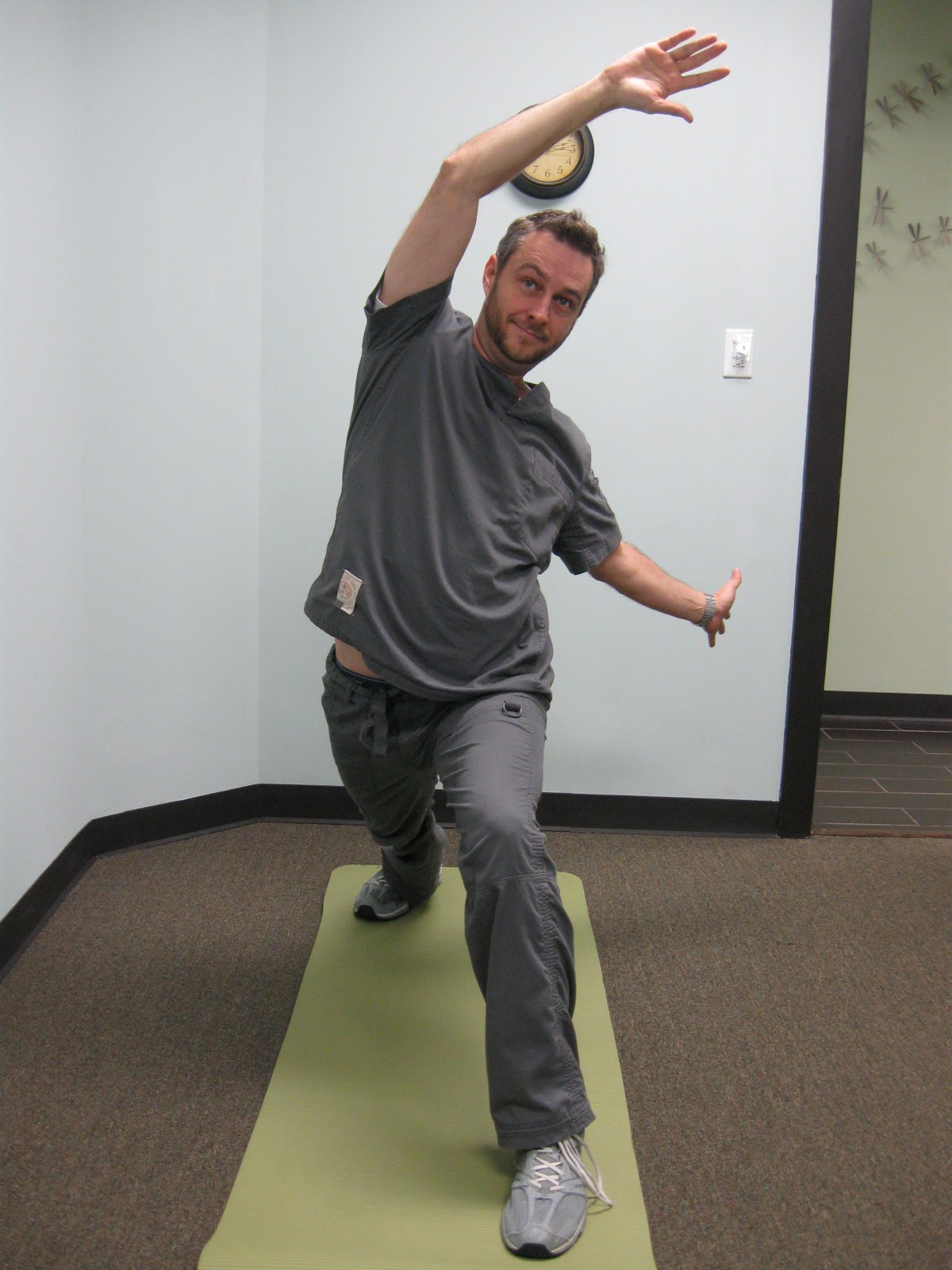
Fortunately, treatment is fairly straight forward--spinal manipulation can open the joints up and give them some breathing room, and some simple stretches will, over time, lengthen the hip flexors that are causing all the trouble in the first place. And so as not to leave you hanging, here are some pics of those stretches:
 Pete demonstrates the basic stretch for the left hip--hard on your knees without the mat.

 Raise your arms up to sink further into the stretch.

 The standing version

 By twisting and bending away from the hip you're stretching you can get a little more out of the movement